
Student Guidance
Preparing a path for the future
Whether your child is going to college, the military, trade school or the workforce after high school, it’s important to start planning right away. We will set your child up for success; now it’s time to show the world what they can do.
For access to local scholarship opportunities, please enter the password provided to you by the site administrators.
Beyond St. Vincent
College and Career Planning
The College Fair will be held on Wednesday, September 30, 2026 from 7:40 a.m. to 10:30 a.m. This is such an important event in your college and career planning journey! Many reps coming from military branches, technical/vocational schools, 2 year and 4 year colleges/universities.

College Reps visit St. Vincent in the fall and winter every year. High school students are allowed to attend. They are asked to sign up if the counseling office at least one day in advance. If there is a rep that you would like to see that is not on this list, please contact Mrs. Tomlinson Specific dates of each visit will be posted on the calendar and on our daily announcments.
Every year the Guidance Counselor, Mrs. Crystal Tomlinson, hosts a college and career planning meeting for high school students. The purpose of the meeting is to start planning for your future by exploring a "to do" list in order to search and select a post secondary career and/or school. Listed below are the the dates of the grade level meetings, along with a packet of information that will be discussed at the meeting.
- Thursday, August 20: Senior College & Career Planning Meeting
2026-2027 Senior College & Career Planning Presentation - Monday, August 24: Junior College & Career Planning Meeting
2026-2027 Junior College & Career Planning Presentation - Wednesday, September 30: College & Career Fair @ Perry Park Center
- Monday, November 9: Sophomore College & Career Planning Meeting
- Monday, November 16: Freshmen College & Career Planning Meeting
Click on the link to register for the ACT today
ACT Registration
The Military will administer the ASVAB. Please sign up in the counseling office.
The Eligibility Center determines the academic eligibility and amateur status for all NCAA DI and DII and NAIA athletes. It does this by reviewing the student athlete’s academic record, testing scores, and amateur status to ensure conformity with NCAA or NAIA rules. The NCAA recommends student athletes register at the beginning of their junior year in high school, but many students register after their junior year. There is no registration deadline, but students must be cleared by the Eligibility Center before they receive athletic scholarships or compete at a Division I or II institution. Please contact your future college or university for more information, questions, deadlines, etc. Reach out to your counselor to have your transcripts sent to the NCAA or NAIA Eligibility Center in May.
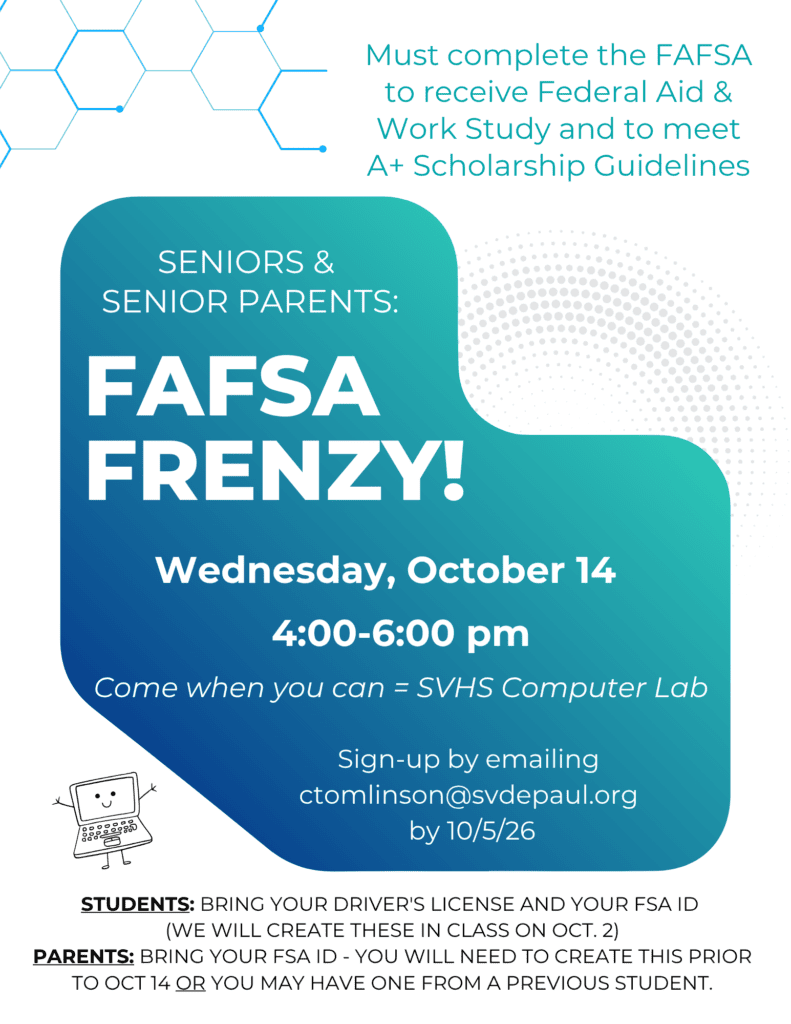
The FAFSA (Free Application for Federal Student Aid) is an online form required to apply for federal student aid, grants, work-study, and loans. It helps determine your eligibility for federal financial aid to help pay for college. The FAFSA is free to complete and submit. It may also be necessary for scholarships. Every year we have a FAFSA Night for seniors and one of their parents. We have professionals from the Mineral Area College Financial Aid Department here to answer any questions or issues you may have. We encourage all seniors and their parents to join us for our
- Wednesday, October 14, 2026
- 4:00-6:00 p.m. in SVHS Computer Lab
At St. Vincent High School, one of our priorities is to provide your child with a strong academic foundation and the skills needed for future success. As part of this commitment, students participate in various forms of testing throughout the school year.
We want to emphasize that the primary goal of testing is not simply to assign grades, but to measure student learning, identify areas of strength, and highlight areas where additional support may be needed. Assessments give teachers valuable information that helps them adjust instruction, provide targeted interventions, and ensure that every student is progressing toward graduation requirements and college or career readiness.
What happens with the test results?
- Teachers carefully review results to guide classroom instruction and provide individualized support or enrichment when needed.
- School leaders use the data to evaluate programs, curriculum, and teaching strategies to ensure they are effective for all learners.
- Counselors and academic advisors may use the results to help guide students in course selections, interventions, or enrichment opportunities. Test results are recorded on the students cumulative record and in the guidance office.
- Scores are given to the students with explanations regarding what was tested. Results are given in comparison with national, state, or local norms when available.
Scheduled Testing
*NWEA - This test is given to students K-8. The NWEA MAP (Measures of Academic Progress) test is designed to measure your child’s growth and achievement in core subjects such as reading, language, science and mathematics. Unlike a traditional test, it adapts to each student’s level—becoming more challenging when they answer correctly and adjusting when they struggle. This helps provide a detailed picture of what your child already knows, what they are ready to learn next, and how we can best support their academic progress throughout the school year.
*Pre-ACT - This test is given to students in 9th and 10th grade. The PreACT is a practice version of the ACT that helps students get a preview of the types of questions and skills they will encounter on the official college entrance exam. It measures achievement in English, math, reading, and science, and provides valuable feedback on academic strengths as well as areas for growth. Results also give students an early indication of college and career readiness, helping them make informed decisions about future courses and preparation for the ACT.
*ACT - The ACT is a college entrance exam that measures a student’s skills in English, math, reading, and science, with an optional writing section. It is widely used by colleges and universities as part of the admissions process and also provides an indicator of college and career readiness. ACT scores can help guide students in course selection, scholarship opportunities, and post-secondary planning, making it an important step in preparing for life after high school.
*ASVAB - The ASVAB (Armed Services Vocational Aptitude Battery) is a multiple-choice test that measures a student’s strengths in areas such as math, reading, science, and technical skills. While it is commonly used as part of the military entrance process, it also serves as a valuable career exploration tool for all students. The results help identify academic strengths and potential career pathways, giving students insight into both civilian and military opportunities after high school.
*Renaissance STAR Test-Grades 9-12 - The Renaissance STAR Test is a computer-based assessment used in reading and math that helps teachers understand each student’s current skill level and growth over time. The test adapts to each child’s responses, becoming easier or more challenging as they answer questions, which gives a more accurate picture of what they know and what they are ready to learn next. Results are used by teachers to guide instruction, set goals, and provide the right support to help every student succeed.
DreamBox Reading Plus Assessment, 3rd-12th Grade - This is known as InSight, is a computer-adaptive diagnostic tool designed to evaluate students' reading proficiency in areas such as silent reading fluency, comprehension, vocabulary, and motivation. It provides educators with a comprehensive understanding of each student's reading abilities, guiding personalized instruction and intervention strategies It serves as a formative assessment used by schools to monitor student progress and inform instructional decisions. The assessment's validity and reliability are supported by its strong correlation with other widely recognized assessments, such as the MAP Reading test, and its alignment with national standards.
Scheduled Testing is as follows:
- NWEA Assessments: Grade 8
- Pre-ACT: Grade 9-10
- ACT: Grade 11-12
- ASVAB (Armed Services Vocational Battery): Interested Grade 10-12
*Students can register for the ACT at www.act.org; SVHS ACT Code is 262-590.
If you are applying to a two-year college or technical/trade school, the school may require the Accuplacer Test. Check with your school to see if you need to take this test. Listed below are the nearest locations and the contact person. You will need to schedule a time to take the test. The Accuplacer covers three areas—Math (Elem Alg), Reading, and English (Sentence Skills).
- Perryville Area Career Center: Mrs. Kym Bock 573-547-7500 ext. 571
- Perryville Higher Education Center: Mrs. Brandy Behrle 573-547-4143